

The feature that seems essential today might be the one that kills your startup tomorrow.
I’ve seen it countless times: brilliant entrepreneurs with revolutionary medical device ideas who are absolutely convinced they need every single feature they’ve imagined. They spend months perfecting elegant user interfaces, developing sophisticated algorithms, and building comprehensive feature sets—while their competitors with simpler, more focused products race past them to market.
The harsh reality? In medical device development, the perfect product is often the enemy of the profitable company.
Your grand vision might be inspiring, but it’s also expensive, time-consuming, and potentially fatal to your startup. The companies that survive and thrive are those that master the brutal art of feature elimination—building minimum viable products (MVPs) that solve real problems for real customers without breaking the bank.
The Customer Knowledge Imperative
Before we talk about what to cut, we need to talk about the most critical question in medical device development: who exactly is your customer, and what will they actually pay for?
This isn’t about what they say they want in surveys or focus groups. This is about what they’ll actually open their wallets for when your device is sitting on their procurement desk.
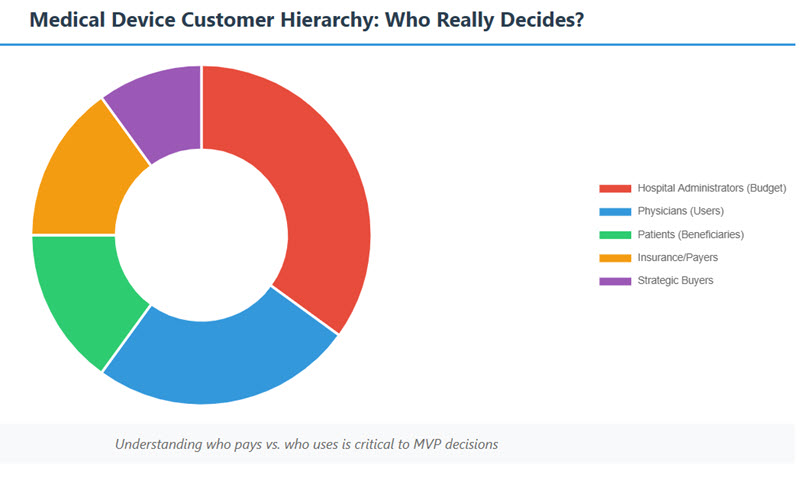
The brutal truth: the person who uses your device is rarely the person who buys it.
Hospital administrators care about cost reduction, workflow efficiency, and regulatory compliance. Physicians care about patient outcomes, ease of use, and reliability. Patients care about comfort and results. Insurance companies care about cost-effectiveness and proven outcomes.
Your MVP needs to address the concerns of the person who actually signs the check—and that’s almost always the administrator, not the end user.
The Best Development is None at All
Here’s the most counterintuitive advice I can give you: the best development is none at all.
Before you write a single line of code or design a single circuit, spend your time and early money figuring out exactly who will buy your product and why. Not who might be interested. Not who thinks it’s a cool idea. Who will actually cut you a purchase order.
I’ve watched entrepreneurs burn through millions developing products that were technically brilliant but commercially worthless because they never validated the fundamental assumption that someone would pay for their solution.
The MVP Decision Framework
When deciding what to include in your MVP, use this ruthless decision framework:
1. Does it directly solve the buyer’s primary problem?
Not the user’s wish list. Not your technical capabilities. The specific problem that the person writing the check is trying to solve.
2. Is it required for regulatory approval?
If the FDA won’t clear your device without it, it’s not optional.
3. Does it differentiate you from existing solutions?
“Nice-to-have” features that don’t create meaningful differentiation are expensive luxuries you can’t afford.
4. Can customers achieve their goals without it?
If they can get 80% of the value with 20% of the features, build the 20%.
Everything else goes on the “Version 2.0” list.
Real-World MVP Examples
Let me show you what effective MVP thinking looks like in practice:
Case Study: Cardiac Monitoring Device
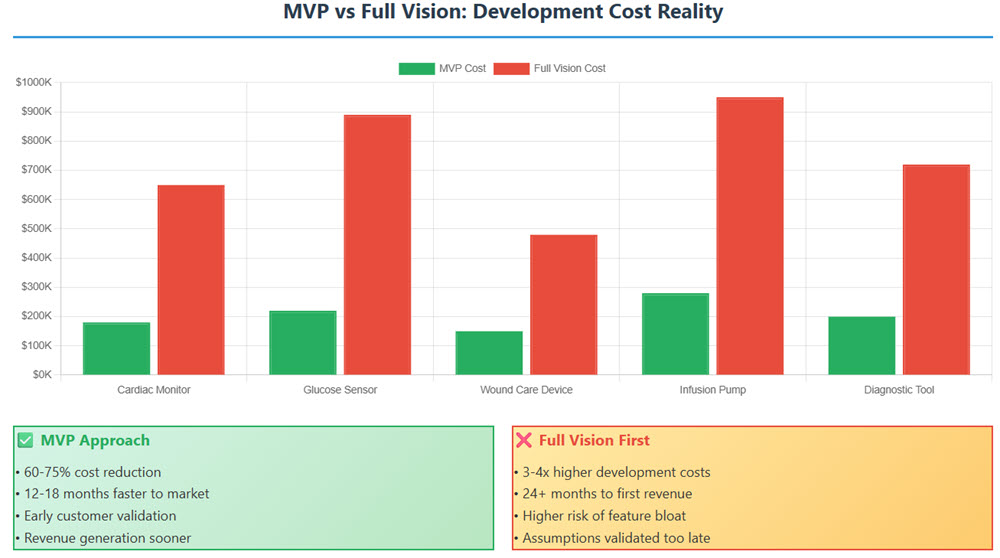
Full Vision: Real-time ECG monitoring with AI-powered arrhythmia detection, cloud analytics, physician alerts, patient mobile app, family notifications, and integration with 15 different EMR systems. Development Cost: $650,000 Time to Market: 24 months
MVP Version: Basic ECG monitoring with simple arrhythmia alerts and integration with the two most common EMR systems in their target market. Development Cost: $180,000 Time to Market: 8 months Result: Secured pilot programs with three hospitals, validated core value proposition, raised Series A funding to build full feature set.
The MVP generated revenue 16 months earlier and cost 72% less to develop. The company used early customer feedback to refine their full vision, ultimately building a more successful product than their original concept.
The Feature Creep Problem
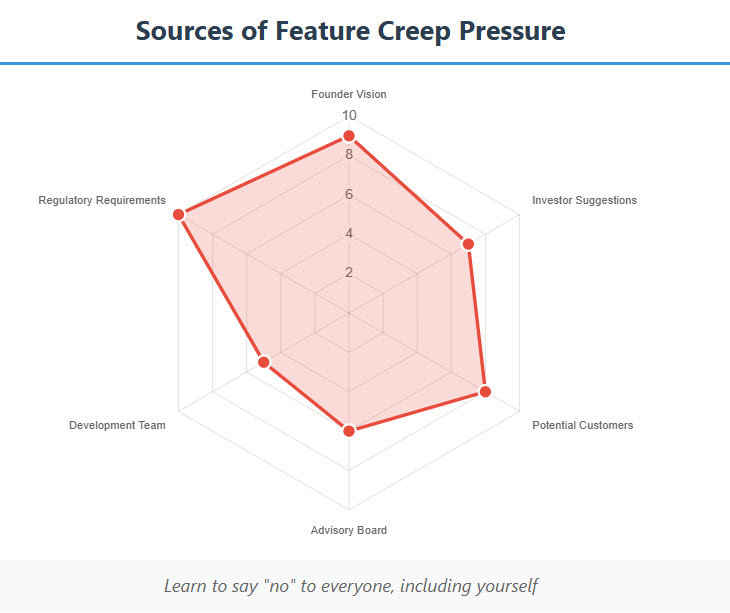
Even with the best intentions, feature creep will try to kill your MVP. Here are the most dangerous sources:
1. Your Own Vision
This is the hardest one. You fell in love with your comprehensive solution, but your MVP needs to be ruthlessly focused. Save the vision for Version 2.0.
2. Investor “Suggestions”
Investors love to add features. They think they’re being helpful. Learn to smile, nod, and add their ideas to your “future considerations” list.
3. Potential Customer Requests
“It would be great if it also did X, Y, and Z.” Unless they’re willing to pre-purchase based on your MVP, their wishlist isn’t your priority.
4. Regulatory Creep
Sometimes regulatory requirements genuinely require additional features. But often, what seems “required” is actually just one interpretation of the regulations.
The Revenue Focus Strategy
Every decision about your MVP should flow from one simple question: what gets us to revenue fastest?
Revenue validates your business model, provides cash flow, and dramatically increases your company’s value. Everything else is secondary.
This isn’t about building inferior products. It’s about building focused products that solve real problems for real customers who are willing to pay real money.
The MVP Implementation Checklist
Ready to build your MVP? Use this checklist to stay focused:
✅ Customer Validation
- [ ] Identified specific buyer persona (not just user)
- [ ] Documented their primary pain point
- [ ] Confirmed willingness to pay for solution
- [ ] Validated preferred purchasing process
✅ Core Functionality
- [ ] Defined single primary use case
- [ ] Eliminated all “nice-to-have” features
- [ ] Confirmed regulatory minimum requirements
- [ ] Identified key differentiation from competitors
✅ Technical Scope
- [ ] Selected simplest technical approach
- [ ] Leveraged existing components where possible
- [ ] Minimized custom development
- [ ] Planned for manufacturability from day one
✅ Go-to-Market Readiness
- [ ] Identified first customer prospects
- [ ] Developed pricing strategy
- [ ] Created basic marketing materials
- [ ] Established sales process
Common MVP Mistakes to Avoid
Mistake #1: Building for everyone Your MVP should solve one specific problem for one specific customer type exceptionally well.
Mistake #2: Over-engineering Good enough is actually good enough for an MVP. Perfect is the enemy of profitable.
Mistake #3: Ignoring manufacturing Design for manufacturing from day one, or you’ll face expensive redesigns later.
Mistake #4: Skipping customer validation Build for confirmed customer needs, not assumed ones.
Mistake #5: Feature matching competitors Focus on solving the problem better, not matching every competitor feature.
The Path Forward
Building an effective MVP requires discipline, customer insight, and the courage to say no to good ideas in service of great outcomes. It’s not about building less—it’s about building smarter.
Your comprehensive vision isn’t wrong; it’s just premature. Use your MVP to validate your core assumptions, generate revenue, and build the customer relationships that will inform your full product development.
In our next article, we’ll tackle the grant funding maze—exploring when grants like SBIR and STTR make sense, and when they’re just expensive distractions from building a real business.
Remember: the feature that seems essential today might be the one that kills your startup tomorrow. Stay ruthlessly focused on what customers will actually pay for, and save the rest for Version 2.0.